 What Is CarrierScreen?
Most of us are carriers of at least one genetic condition.1 While many individuals are healthy and have no known family history, there is still a risk of passing an inherited condition on to children.
Carrier screening is a type of genetic carrier test that determines whether you carry a gene alteration linked to specific inherited diseases. Carriers typically do not show symptoms, and in many cases, there is no known family history.
However, if both partners are carriers of the same condition, there is a risk of having a child affected by that condition.
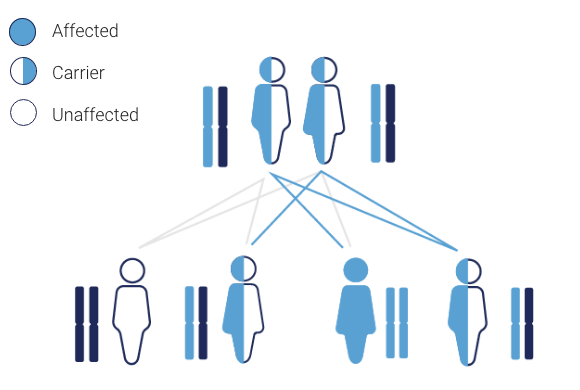
CarrierScreen offers inherited disease screening and recessive gene testing, helping individuals and couples better understand their reproductive risk.
Carrier screening can be done:

Before pregnancy (preconception genetic testing)

During pregnancy
This allows individuals and couples to make informed decisions about family planning.
Who can Benefit from Carrier Screening?
Clarify potential genetic risks prior to starting a family to empower informed decisions.

Stratify risk in high-risk populations (e.g. Ashkenazi Jewish).

Ensure gamete donors and recipients are matched accurately to minimise genetic risks.

Reduce emotional and financial burden associated with unexpected genetic conditions.
Benefits of CarrierScreen

Natural conception with an option of prenatal testing, such as amniocentesis or chorionic villi sampling, for the specific condition

In vitro fertilisation (IVF) with preimplantation genetic testing (PGT)

Use of a sperm or egg donor who is not a carrier for the condition

Adoption
How CarrierScreen Works
CarrierScreen must be requested by a healthcare professional


Genetic counselling is strongly recommended before testing

The Test Requisition Form (TRF) must be completed and submitted

An invoice is issued by Next Biosciences

A saliva collection kit is couriered to you for testing

Once completed, the sample is collected and sent to the laboratory
Results are available in approximately 3–4 weeks

Results are sent to your healthcare provider, who will discuss them with you
Understanding Your CarrierScreen Results
If you are identified as a carrier, your partner or donor may need testing

If both partners are carriers of the same recessive condition:
There is a 25% (1 in 4) chance of having an affected child per pregnancy

For X-linked conditions:
There may be up to a 50% chance of having an affected child

If both partners are not carriers of the same condition:
The risk is significantly reduced

Speak to a Genetic Counsellor
Understanding your results and next steps is important when considering carrier screening in South Africa.
Ask your healthcare provider about CarrierScreen
Frequently Asked Questions
Find answers to common questions about Carrier Screening:
Regulatory and Partnership Information
Next Biosciences is an authorised distributor of Natera’s Horizon Test in South Africa.
This content has not been reviewed or endorsed by Natera, Inc. Next Biosciences is responsible for maintaining content in line with partnership guidelines and South African regulatory requirements.
Accreditations include CAP accreditation, ISO 13485, and CLIA certification.
© 2024 Natera, Inc. All rights reserved.
References
- Bell et al. Sci Transl Med. 2011;3(65):65ra4